

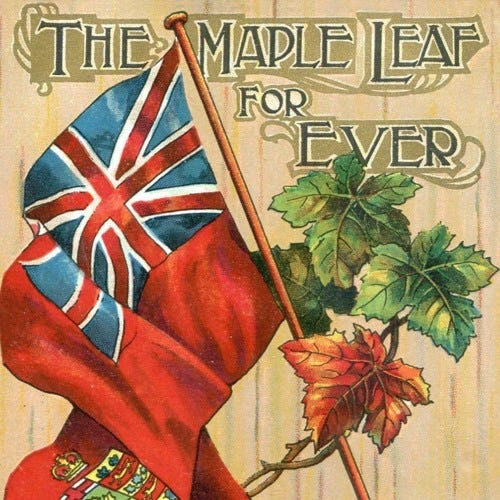
The Maple Leaf Forever
On Dominion Day and the Canadian Inheritance

A Nation That Forgets Its Story
A nation that forgets its story eventually forgets itself.
Every country tells a story about who it is. Some tell stories of conquest. Others tell stories of revolution. Canada, increasingly, tells a story of apology.
There is wisdom in confronting the darker chapters of our past. No mature nation should sanitize its history or mistake patriotism for perfection. But neither should it permit its history to be reduced to a single moral indictment. A people who remember only their failures eventually forget why they built a country in the first place.
Canada is not an accident of geography. It is an achievement of history.
Long before there was a transcontinental railway, a Charter of Rights and Freedoms, or a maple leaf flag recognized around the world, there was an idea: that a free people could build a stable, self-governing nation stretching across the northern half of the North American Continent. That idea was shaped by French explores under the leadership of Samuel de Champlain, who envisioned permanent communities rather than mere trading posts; by British constitutional traditions that gave us parliamentary government and the rule of law; by a mutual intelligibility between British common law and Indigenous legal tradition grounded in precedent and practice; by generations of immigrants who chose not merely to live here, but to become Canadian.
This country was not handed to us.
It was imagined, negotiated, built, defended, and renewed by ordinary men and women who believed that Canada was worth the effort.
Whether it remains so depends upon us.
The Dominion We Inherited
Long before it became Canada Day, July 1 was Dominion Day.
The name was never accidental. Drawn from Psalm 72—”He shall have dominion also from sea to sea”—it reflected the confidence of a young country determined to build a constitutional democracy stretching from the Atlantic to the Pacific and, ultimately, to the Arctic. Dominion did not signify subservience. It expressed aspiration. It spoke to the responsibility of building a nation founded upon liberty, ordered government, and the rule of law.
The Fathers of Confederation accomplished something extraordinary in 1867. While many nations were born through revolution or civil war, Canada emerged through negotiation, compromise, pre-Confederation skirmishes, and constitutional vision. They understood that unity could be achieved without demanding uniformity.
Their work did not end with Confederation.
The Canadian Pacific Railway united a continent. The North-West Mounted Police established the rule of law across an immense frontier. Parliament evolved into one of the world’s oldest and most stable democratic institutions. Our constitutional monarchy provided continuity while governments changed peacefully through the will of the people. The Charter reaffirmed that freedom belongs to every Canadian equally under the law.
None of this was inevitable.
Every generation inherited these institutions from those who came before, and strengthened them for those yet to come.
That is the Canadian inheritance.
More Than Our Worst Moments
In recent years, Canadians have increasingly been encouraged to understand their country almost exclusively through the language of colonialism, oppression, and historical guilt. At times, Canada has even been described as though its entire history can be reduced to a single accusation.
History deserves greater honesty than that.
Canada’s past contains undeniable injustices. Indigenous peoples endured dispossession, broken promises, and government policies—including the residential school system—that inflicted profound and lasting harm. These chapters belong in our national memory. They should neither be denied nor diminished.
But they should not become the entirety of our national identity.
Canada is neither the flawless nation imagined by uncritical patriots nor the irredeemable country portrayed by its harshest critics.
It is something far more remarkable.
A nation that has repeatedly confronted its failures through democratic institutions rather than revolution. A country that has expanded rights rather than restricted them. A society that has welcomed millions seeking freedom, opportunity, and peace while continually striving to become more just than it was before.
To reduce more than four centuries of Canadian history to a single moral verdict is not an act of historical honesty. It is an act of historical erasure.
A mature country remembers all of its history.
Its triumphs.
Its failures.
Its sacrifices.
Its mistakes.
Only then can it understand itself honestly.
And only an honest nation can move confidently into the future.
A Country Worth Building
History is not only what a nation remembers. It is what a nation chooses to do next.
Canada has never been defined solely by geography or abundance. It has been defined by effort. From the construction of the Canadian Pacific Railway to the defense of Vimy Ridge and Juno Beach, from Arctic exploration to scientific and cultural achievement, Canada has been built by generations who understood that nations are not sustained by sentiment alone. They are sustained by work, sacrifice, and continuity.
This country has never been static. It has been shaped by constitutional evolution, democratic expansion, and the steady widening of rights and responsibilities across time. The Canada of Confederation is not the Canada of the Charter era. Yet both are part of the same unfolding experiment in ordered liberty.
Few nations have succeeded in doing what Canada has done: building a stable democratic state across an immense geography, while integrating successive waves of immigration into a shared civic framework. That achievement is not automatic. It depends on institutions that function, laws that are respected, and citizens who understand that participation in national life carries obligations as well as benefits.
Citizenship is not passive. It is not consumption. It is contribution.
Citizenship Is a Covenant
Canada has long welcomed newcomers from every corner of the world. That openness is one of its defining strengths. But openness does not mean absence of expectation. Immigration is not a one-way transfer of benefits; it is an entry into a civic order that already exists.
Citizenship is therefore a covenant.
It binds the individual to the nation, and the nation to the individual, through shared responsibility under the rule of law.
To be a citizen is to accept obligations: to obey the law, to respect the rights of others, to uphold democratic institutions, and to contribute to the common good. These obligations are not conditional. They are foundational.
A society that cannot expect respect for its laws cannot sustain the freedoms those laws protect.
Canada’s generosity has always depended on this balance: welcome paired with expectation, opportunity paired with responsibility, inclusion paired with commitment to the civic order that makes inclusion possible.
When that balance breaks down, when laws are treated as optional, when civic obligations are ignored, when institutions are undermined, the result is not compassion. It is denigration and failure.
The rule of law must apply equally to all who live in this country, regardless of origin or status. Criminality, violence, or persistent rejection of Canadian law cannot be excused on the basis of background. Nor can citizenship be treated as entitlement without responsibility.
Those who come to Canada in good faith, who contribute, who respect its institutions, and who embrace its civic traditions strengthen the country. Those who do not should not expect indefinite tolerance from a system built on mutual obligatare ion and trust.
A confident nare ation is not defined by harshness. It is defined by consistency.
And consistency requires that Canada remain williare ng to defend the legal and civic foundations that make its openness possible in the first place.
The Maple Leaf Forever
There is a reason The Maple Leaf Forever continues to resonate.
The title expresses something timeless.
Not certainty.
Not triumph.
An aspiration.
The maple leaf is more than the emblem on our flag. It represents an enduring promise that people of different histories, languages, cultures, and faiths can become one people without surrendering the democratic principles, institutions, and traditions that define Canada.
Like every national symbol, its meaning depends entirely upon the people who stand beneath it.
A flag cannot preserve a country.
A song or anthem cannot defend a democracy.
Only citizens can. That is the responsibility of citizenship.
Citizenship is about joining into the commonality where there collective obligations, collective responsibilities, and collective rights of citizenry.
On this Dominion Day, it is worth remembering that those who built this country did not expect perfection from future generations. They expected stewardship. They entrusted us with a nation stretching from sea to sea to sea, believing that free people, governed by law and united by common purpose, could build something that would outlast them.
Now that inheritance belongs to us.
Every Dominion Day asks the same question of every generation.
What will you do with the country entrusted to you?
Will you inherit it as consumers or as citizens?
Will you remember only its failures, or also the courage, sacrifice, and vision that built it?
Will you leave behind a nation uncertain of itself, or one that once again knows who it is?
Canada has always been an unfinished project. Its history is not a monument carved in stone but a story still being written. Each generation adds its own chapter. Each generation decides whether this country will grow weaker through forgetfulness or stronger through remembrance.
The measure of our patriotism will never be found in fireworks, slogans, or a flag displayed for one day each July. It will be found in whether we teach our children the truth about our history, protect the institutions that safeguard our freedoms, take seriously foreign interference and crack down on it, defend the sovereignty that generations before us secured, preserve our natural resources while understanding them as part of our national security, and leave behind a Canada stronger than the one we inherited.
If we remember who we are, not by ignoring our failures, but by refusing to let them define us, then the promise of Confederation still lives.
Canada will remain more than a place on a map.
It will remain a nation bound together by memory, freedoms, responsibility, and hope.
And if we prove ourselves worthy of that inheritance, then perhaps those old words will once again speak not only of our past, but of our future.
The Maple Leaf Forever.